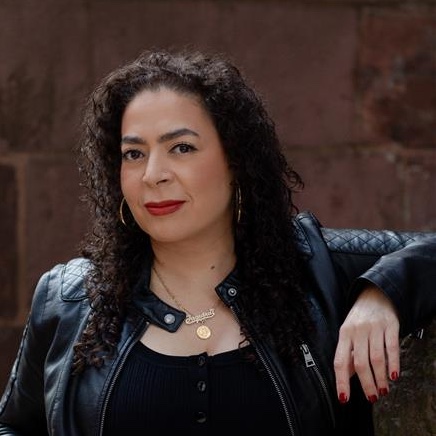
[00:00:00] Speaker A: There was something about the way that salsa was inherently political, how it focused on some of the issues that people in our community were actually living through, such as systemic poverty and drug use, addiction, police brutality. All of these things were existed in salsa music. I definitely wanted there to be a connection between the music and the story.
I want people to feel like there's a soundtrack to this novel.
[00:00:37] Speaker B: Hi, my name is Geraldo Cadava and I want to thank you for tuning in to season four of Writing Latinos, a podcast from Public Books.
We're back for more terrific conversations with Latino authors writing about the wide world of Latinidad.
As always, we aim to provide thoughtful reflections on Latino history, culture, politics and identity and how writing conveys some of its meanings.
Don't forget to like and subscribe to Writing Latinos wherever you get your podcasts. And now for the show.
Our guest today on Writing Latinos is Jakira Diaz, the author of a new novel called this is the Only Kingdom, published by Algonquin Books.
Diaz is an assistant professor of writing at Columbia University and the author of Ordinary Girls, a memoir which won oodles of book prizes. This Is the Only Kingdom is a story of intergenerational trauma, migration, and people who try to better their circumstances, but often end up falling short. Oh, it's also about music. Definitely, definitely about music. You can check out the accompanying playlist for this Is the Only Kingdom on Spotify.
Thank you as always for listening to Writing Latinos.
So first of all, Jacqueline, congratulations on the publication of this Is the Only Kingdom. I really enjoyed it. The first thing I'd like to ask, just so our listeners have some kind of orientation, without giving away the plot fully, can you tell us a little bit about some of the main characters in the story just to get our listeners oriented? Who are Ray and Marie, Carmen and Nenna?
[00:02:28] Speaker A: Thank you so much, by the way, for your kind words. It took me so long to write this book. I feel like I was living with these characters and I've known them.
I feel like, especially for Rey, I feel like I've known re most of my life, even before I started writing this novel. But I'll tell you a bit about each of them. There are four, what I would say four main characters. It's a multi generational novel and Ray is a musician who is also a kind of modern day Robin Hood, if you will, in his community.
He's a very complicated person who deals with addiction, who has a very deep connections with people in his community and he is a person who falls in love and, you know, has a relationship with Marik Carmeng and Mareng is a teenage girl when they first meet, and she also has a very complicated relationship with her community in that she is.
They both come from a working class barrio and she is someone who has a lot of, I guess, a complicated relationship with labor. She works and works and works to in order to help support her family. And she works in people's houses. She works as babysitter, caretaker, and also cleans people's apartments.
And she also is one of the. Comes from one of the only white families in El Castillo.
So the book is set in El Castillo, Padre Rivera in Humacao in Puerto Rico. And it's based on a real community that was mostly black and brown Puerto Ricans. And maritalme belongs to one of the only white families in this community. So she also has a lot of blind spots. And she kind of changes as the story goes on. She grows, of course, but she starts to recognize some of the ways that she's had these blind spots because the black people in her community point them out.
Nena is her daughter who we first meet when she's a baby. And then as the years pass, we see her as a teenager who is coming into her own and having her own coming of age. Rei is black, and Mari Kalmeng is white. So she's a mixed girl who is red as black and being raised by a white mother who doesn't really know how to raise black children. And then there's Tito, who is Rey's little brother, who we first meet as a toddler, and then we get to watch him as a teenager later on in the, in the novel, Re is beloved by his community and, and also despised by the local cops.
And so Tito kind of inherits some of that, those relationships. And then as we see the novel progress, we start to learn that the community and their relationships start to shift.
[00:05:25] Speaker B: It seems to me like we're living in this era when we're widely recognizing Latino diversity, Latino ideological diversity. I mean, I don't know exactly when you would want to pinpoint the beginning of that conversation too. I don't know if it's about Latinos voting for Trump. I don't know if it's conversations about anti blackness or anti indigeneity. It feels like something we're reckoning with recently. But you noted that you've been living with this novel for a long time, and you've been living with figure, a figure like someone. Someone like Ray for a long time. And so we know that racial Tensions within our community are nothing new, but it seems like nationally, hemispherically, there's much more of a public conversation about these things now than there was. Maybe I'm misreading the kind of recentness of the. The widespread conversation about it. But why.
Why do we need to keep insisting on Latino racial diversity, Diversity, ideological diversity? Why isn't it always assumed to be part of the Latino community from the very beginning?
[00:06:39] Speaker A: Thank you for that question.
Which is. Which is really important to me personally and also to my work. I mean, I have been aware of race and racial divide since I was tiny because I grew up in a family that was mixed. My father's side was black, my mother's side was white. And there was a lot of tension there. Even though they're both Puerto Rican and even though they came from the same community, my mother's mother was white and vocally, violently racist. And when my mother had, you know, had us when she married my dad and had us, she still took it upon herself to, like, remind us, remind me and my siblings every day that we were less than, that we would never look like her white family. And this was like, in our family, this was not a stranger. And so part of what I wanted this book to kind of embrace was the idea, like, we can have conversations about race and the way that race plays out in the ways that people are targeted and racialized, even in our own communities, that we should be having those conversations.
I have these conversations in my family all the time, but I didn't realize that people were not having these conversations or were avoiding talking about this until later in life when I realized, oh, wait a minute, no one is actually talking about this. On the contrary, what ended up happening is even within Puerto Rico, that people were like, oh, no, that doesn't exist in Puerto Rico. It was like we were expected to believe that Puerto Rico was post racial because everyone, and I say everyone, is a mix, which is not actually the case. Yes, I think a great majority of Puerto Ricans are a mix of black, indigenous, and European. But some people are just black and some people are just European. Right. Some people are not as mixed as others. And so it's not like a perfect trilogy mixture of races. And so because everyone is a mix, that racism does not exist. There's. There's definitely racism, there's definitely colorism, even within our own families. I think it's important to talk about this and be honest about this so that we start to understand the effects of this, the effects of this violence and also the Erasure of it. I understood this because I was raised by a black grandmother who made me aware of the ways that she was treated out in the world. And I also saw and lived for myself the ways that she was treated when we were out in the world.
People assumed she was my nanny. And this infuriated me because I wanted people to understand that she was my grandmother. I adored her. And so I, like, would react in a hostile way when people, like, would ask her if she was my nanny. And I would be like, she's my grandmother. And I would be infuriated. And then my grandmother would always correct me and tell me, no, you can't behave this way in front of people. It's better to just have these conversations and talk to them in a way that they will actually listen to. If you react this way every single time this happens, no one will ever listen to you. And I started to understand, like, this was her life constantly, and she had ways of having these conversations. She didn't want to feel like she was being attacked or targeted. She wanted to feel like she could move through the world even when she had to negotiate a certain kind of safety for herself. And so I think having the conversations, all of us having the conversations, all of us participating and like, dismantling the system and learning, not just saying, oh, I know all about race and moving on, actually continuing to learn and educate ourselves and educate our people is really important, I think. Anti black racism, anti indigenous racism, Colorism hurts everyone. Not just the people that we assume are targeted by it, but it hurts everyone. It hurts us all as a society. And on top of this, part of what happens when you leave, you know, Latin American countries, when you leave Puerto Rico and come to the US Is those same systems that, you know, white people in our back home are using against indigenous people and black people are used against all of us, because they read us all as this great big brown mass when we're not. That's not what we are. And so learning to actually learning the effects of how this affects everyone, learning how to dismantle these systems is really important because anti blackness, anti indigeneity is global. It exists in every single country in the world, and it affects us all.
[00:11:01] Speaker B: I'm so glad you reminded us of the myth in Latin America and so many Caribbean countries about colorblindness and mixture, because I think I tend to think of this primarily in a US political context. And you talked about, like, the big brown mass of Latinos and how that's how they see us. What I'm interested in also is the ways in which we project that ourselves. Because we think that to achieve some sort of political power, we have to present a united front. I'm really interested in this change to the 2030 census where Latino civil rights organizations, advocacy groups have tried to create Latino as a separate race, but as a single race, you know, and it's been primarily Afro Latinos who've pushed back against that with slogans like Latino is not a race. Nevertheless, groups like Naleo and others are still.
They've been championing this change to the 2030 census for a long time to present unity, because I think they believe that there's power in numbers, you know, that if we can present a united front as Latinos, then we can achieve greater and bigger things.
I was also going to ask you about homophobia. The book is also a kind of coming out story and a story of self discovery. And I wondered if that homophobia within Latino communities works kind of similarly as anti blackness and anti indigeneity, or does it have kind of unique inflections?
[00:12:35] Speaker A: One of the things I tried to present in the novel is how even though homophobia and anti black racism are different things, they are interconnected and they're in fact interconnected in that their.
Their ways of oppressing and targeting people, their systems that affect all of us, even if we don't think it's obvious. We don't see the. The obvious, the way they affect all of us, but one of the ways that they're the same is that they're actually fueled by power. Right? People have a certain level of power and they want to hold on to that power. And in order to do that, they have to oppress other individuals that are different from them, even though that doesn't necessarily happen that consciously. I definitely wanted to. To show how homoph lives in our communities. In the case of El Casterio Padre Rivera, and particularly in this time and place that I'm talking about in the novel, I wanted to show how the Catholic Church was actively responsible for fueling some of that homophobia in the ways that they were denying, particularly gay men and people who had died of AIDS during the AIDS epidemic or at the height of the AIDS epidemic, how they were denying them funerals because they thought that performing a funeral mass for a gay person was like accepting that homosexuality was not a sin, or that it was okay, or that performing a funeral for a person who had died of AIDS was seen as condoning homosexuality because AIDS was considered a gay disease. Like they thought no one else died of aids. Only gay men died of aids. The Catholic church is everywhere in Puerto Rico. Every single town and city has at its center, in El pueblo, in the center of town, a Catholic church. And the plaza where people gather is built around this Catholic church. And this is in every single town. What are they? 78 municipalities. That's 78 plus Catholic churches.
And so in a very tiny archipelago. And the Catholic Church, essentially, during that time, the 70s and 90s, early 70s and early 90s, had a lot of power in that people went to the Catholic church because. Not just because they wanted to find religion, but they wanted to find community.
This is where they found community.
And this is where families went on Sundays and they celebrated and continue to celebrate, like during the week. It's not just Sundays. And so I wanted to show how this center of religion, spirituality, and culture was actually a center of power that was.
That was propelling this homophobia and this hate, you know, against queer communities.
But also I, you know, there. There's some irony in that. Mari Calmen, who is one of the main characters, is actually a very active Catholic.
And Nena grows up in the church, and so does Tito. These two queer kids grow up in the church, and they're actively fighting against this idea that the Catholic church says that they will not make it to heaven because they're queer, and that's a sin that they're basically going to burn in hell. And so one of the things that I wanted the novel to suggest is that the Catholic Church is created as a system of power and that the Catholic Church, how it exists in the novel, is actively participating in the oppression and violent oppression of. Of queer people. And even though that is happening, there are still ways that people like Marikalmeng, Nana and Tito are actually looking for spirituality, looking for some sense of spiritual fulfillment.
But I also wanted to show that the ways in which every single one of these characters acts is not just, you know, things don't just happen in a vacuum. They're also actions as a response to some of these things, such as homophobia and anti black racism, and that they're all interconnected. For example, Blanca's racism is not just, you know, Blanca wakes up one day and decides that she's going to hate black people. Blanca's racism was born out of a system that taught her that if she hated black people, then she was not part of those people and she was better. And it taught her that she needed to do this in order to be better.
And it's the same thing with homophobia. Homophobia is teaching people that they will go to heaven if they're not gay. And so those people over there, they're not going to heaven, so they are better.
So I wanted to show how these things are interconnected, how people's actions reflect these systems. They're not just happening in a vacuum. If you notice when we learn that Blanca is racist, we live with that for a while, and then we actually get to meet her and realize she's also homophobic. She's also deeply homophobic. It's not just she's racist. And all the things that she doesn't like about her own granddaughter are things she interprets as her granddaughter being too black and her granddaughter being too masculine.
[00:17:46] Speaker B: Writing Latinos is brought to you by Public Books, an online magazine of ideas, arts, and scholarship. You can find
[email protected] that's P U B L I C B O O K S.
To donate to public books, visit publicbooks.org donate it felt to me like intergenerational traumas were kind of hanging over the lives of many of your characters. And you have a lot of people who are kind of trying to better their circumstances by finding meaningful and loving relationships or economic security, but then they also are always kind of falling short and finding themselves back where they began, as if the past and the kind of foibles of earlier generations are never entirely escapable. And so I was thinking about, you know, Nena's migration from Puerto Rico to Florida, but then she ends up back in Puerto Rico. I was thinking about how the novel begins with Ray and ends with rhe, too. You're kind of coming, always coming back to points of origin in some ways. So I was wondering how you were thinking about what the relationship between the experiences of generations is in the story.
[00:19:08] Speaker A: I was definitely thinking of intergenerational trauma, particularly as I was writing the very early drafts and the story of re in part because I knew early on that Ray's character, his story arc, would affect every single one of the people in the novel, that his story is something that they all live with.
And I wanted to show how even someone like Nena, who was very young, who was like next generation, is his daughter, doesn't really realize at the time how much the story affects the person she becomes, but that his character arc definitely does affect her. It has a real impact on her life and the person she becomes as she gets older.
[00:19:55] Speaker B: And I was also thinking with the character of Nena, a lot of her, I guess, personal growth happens as she moves from Puerto Rico to Florida and the different communities that she meets while in Florida. And so, you know, part of this is almost a common trope in Latino stories that moving to the United States presents an opportunity. Often we talk about it in terms of bettering your economic circumstances, trying to live an American dream. But I think in Nana's case, it's also about coming into relationships with different kinds of people in South Beach. And so I guess I'm just wondering, in this novel, you know, how does migration and moving to the United States also relate to that question I just asked you about, about escaping your circumstances, never fully being able to escape those kinds of things.
[00:20:50] Speaker A: So one of the things that became very obvious to me as I was writing Nana's story when I had her arrive in Miami and suddenly find herself, like, looking for a job, is that I didn't want this story to be like, oh, we left terrible circumstances in Puerto Rico, and now we're in Miami beach, and things will be better because this is a better place. I didn't want that to be the story. Instead, I wanted to show as a person who, because of her relationship with her mother, has to grow like she is. She realizes that she has to overcome this abandonment, and she becomes a different person, not because of her location, but because of her relationship with her mother and what has happened between her and her mother. She becomes the person who has to get things done, who takes care of herself, and who is actively trying to find the things that she wasn't able to get from her relationship with her mother. She's trying to find family and community. And for her, that has to happen in Miami only because that's where she is. But it's not the place that actually necessarily changes the person she becomes. And so her looking for this community and finding this community is a direct result of her mother's abandonment. But what she does find, I mean, what Ina wants more than anything else is family and love. And what she finds is family and love. It's a queer family, something she wasn't able to find in where she came from in El Castillo, that something she only had with Tito. And so I wanted to show that, like, for example, the racism and homophobia is not just a Puerto Rican thing. It's not just the thing that happens in Puerto Rico.
She encounters the same thing in Miami. So for her, her circumstances change, but the racism and homophobia and these systemic problems don't change.
She only actually learns that racism is everywhere, homophobia is everywhere, no matter where you go. One of the things that I Wanted to show when she finds this community. She starts working at this pharmacy at the height of the AIDS epidemic, and she's learning for the first time the effects of systemic homophobia, which is that so many queer people are suffering because they don't have medications for aids. They suddenly get this cocktail. But it's been so many years of that, people with aids have been living with aids without medication, that she actually starts to experience the loss of almost an entire generation of gay people. And she's coming to this moment of awareness as a teenager, which is a really difficult thing for her to recognize. What she finds in Miami, in this community, is someone who is a young gay boy who is almost.
Who reminds her very much of her relationship with Tito, who is a young gay, effeminate boy who adores her, who loves her. And she finds someone who loves her, who is very much his own person.
But she learns that family is not just blood. That family can be community. And the people who choose to love you, who see you for who you are and love you anyway, and you don't have to actually excuse yourself or justify your behavior or who you are in order to be loved. And I wanted to show that this.
This was a possibility even at the height of the AIDS epidemic, when so many people were suffering and dying. I wanted to show that there was still community and love and that, as I said, that all the things, all these systems and these violences that she encountered in Puerto Rico were still very much present in Miami Beach. Her returning to Puerto Rico, actually, I didn't see as necessarily returning to Puerto Rico. I saw more as returning to her mother, because she has become the person who gets things done, the person, even though she's very young, who will take care of her mother, Even though, as she sees that her mother did not take care of her.
There to be a moment when we understand that for Nena, it's not, I left Puerto Rico for a better place. It's I left these circumstances, and now I'm going to make my own circumstance. I'm going to write my own story and make my own life. And yes, we will eventually return to Puerto Rico, but we'll be in a different place, and we're going to write that story on our own rather than we're going to be victims of circumstance.
[00:24:56] Speaker B: I want to talk about music, because it was only when I read your liner notes at the very end of the book that it dawned on me like, oh, all of the chapter titles are quotes from songs or song titles. And again, I don't know what it says about me as a reader that it took me that long to realize. But then I thought about how, like, yeah, I didn't. I didn't really read this novel as a book about music.
But music is everywhere. I mean, it's in the titles. Ray is also a musician, if I remember right. Mari Carmen, I think, you know, whenever she's going to do errands or clean the house or something, is listening to music in the background and kind of has a soundtrack. I also noticed in the acknowledgments that you have, at some point in your life, danced until dawn, listening to Bad Bunny in Las Vegas.
So music is important. It's important in the story. It's important to you. So. But at the same time, I didn't feel like it was a book that was about music. It was about all of these other things that we've been talking about. But I guess music also captures all of those other things. So I wanted to ask you, in the story, in your life, what is the importance of music? Why did you want to have that kind of be an anchor in some ways?
[00:26:12] Speaker A: I love this question.
First, personally, music is very important to me. I studied music as a child. I played piano. I sang individually, and I sang in chorus. And I also played bass.
And I went years thinking that I was going to be a musician, that I was going to be in a jazz band.
I was in a band with my friends. We wrote R and B song, we sang them. We went to karaoke together and pretended we were stars. And so for a really long time, I went through my life thinking that I was going to make music.
But I also am hard of hearing. I have almost no hearing in my left ear. And so music also became really difficult for me.
And so I stopped playing. And now I just write about music. I write some music criticism, music journalism, but music is always in my work in some way. Music was certainly a big part of my first book. It's also going to be a big part of my third book, which I'm now writing. In this book in particular, though, the music was inspired actually by a song.
I've talked about this a little bit, but Ray's character was inspired by a real person.
It was a story that was passed down to me by my father of a real guy named Ray. And he was kind of like a neighborhood Robin Hood who was beloved by the community and despised by the police.
And he was killed by the police. There were lots of witnesses. It became a story that was passed down among the Community. And when I learned about Ray, the real person, not the character in the novel, I was a child and I was road tripping with my dad. And we stopped at a gas station, and my dad had pumped gas and came back in the car, and this song was playing on the radio. It was Pedro Conga's Real Chino, which is a salsa song. And my dad asked me, oh, do you know the story behind the song? And I said, no. And then my dad told me the story about Ray, who was the real person who was killed by police, who was beloved by his community and despised by the police.
And at first I thought, wow, this is kind of amazing that real people are in music or in songs, that people that my dad knows are, like, part of this history, but also that my dad knows an actual musician who went on to become, like an international salsa band leader. Pedro Conga was at the height of, you know, salsa's golden age.
Everybody knew Pedro Conga. Everybody dances music.
And then I realized that there was something about salsa in particular and the way that salsa used storytelling that I found really incredible. I already thought of myself as a very musical child, and I used to write songs, but I thought there is something about the ways that these salsa songs are telling stories that to me, felt really powerful.
I loved poetry, and I loved poets and I loved writers, and I already thought of myself in a way, as a writer, even though I had no idea how to put a story together. But there was something about the way that salsa was inherently political, how it focused on some of the issues that people in our community were actually living through, such as systemic poverty and drug use, addiction, police brutality. All of these things existed in salsa music. And. And so when I started writing this novel and started thinking of this novel as not as a retelling of re story, but kind of as a tribute to his story, Creating this character, giving this character of a fictional family. I thought about this song and how this song in some ways inspired the storytelling.
And so I wanted to include something that was similar to the song. And then I thought, I'm just going to make Ray a musician and have music be alive in this novel, in the world of this novel.
And the.
The Ray's talent, like his singing, became part of the story.
But then also, I'm obsessed with salsa. I listen to salsa all the time. Most of my playlists are salsa. I listen to salsa as I'm writing.
And I had a playlist for this novel. And then I started thinking, wait, I'm not writing a novel. I'm writing an album. This is going to be kind of like the old school salsa albums, like during the time of the Fania All Stars where you have double sided albums that have lots of songs and lots of stories within these songs. And then I realized I can't write an album because I'm not actually a musician. I have to write a novel. But I definitely wanted there to be a connection between the music and the story.
But I realized that I didn't just want to talk to a very small audience. I wanted the book to feel inviting even to people who know nothing about salsa or nothing about music, which is why I included the liner notes. I want people to feel like there's a soundtrack to this novel.
I purposely deliberately listened to the song that that's part of the of the title in each of the chapters. I listened to that song and I try to match the tone of the song in some ways. Like, you'll notice that El Cantante is a little bit faster. El Raton, the chapter moves a little bit more slowly and it's a little bit, I want to say erotic in some places.
It's a little bit sensual. And so I wanted readers to feel like if they listen to their soundtrack as they're reading, there's something about the tone of the song that feels like it matches the story. They're also thematically connected. If you know something about, for example, Granbaron or Tume Quemas, what's happening in the song thematically kind of echoes what happens in the novel and vice versa. So if you know something about salsa, you'd realize, oh, wait a minute, has to be about some kind of queerness if you're familiar with that song. But if you don't know, then it's kind of like the playlist or the liner notes become kind of like a way for you to actually discover something about music that you didn't know before.
[00:32:08] Speaker B: I love that. And did you actually create a playlist on Spotify or somewhere else to accompany the book that all listeners can go just listen to the soundtrack of the book?
[00:32:17] Speaker A: Yes, there is a playlist on Spotify and there's a playlist on Apple Music and it's called this is the Only Kingdom. Yeah, there's a playlist.
[00:32:27] Speaker B: That's great. I'm going to listen to it this afternoon. I want to thank you, Chakira, for joining us on Writing Latinos. And I also want to thank you for writing this is the Only Kingdom. I think listeners are going to really enjoy the book and this conversation about it.
[00:32:40] Speaker A: Oh, thank you so much for having me and for your questions.
Foreign
[00:32:55] Speaker B: thank you for listening to Season four of Writing Latinos.
We'd love to hear your suggestions for new books that we should be reading and talking about. Drop us a line at geraldopublicbooks.org that's G E R A L D
[email protected] this episode is brought to you by Public Books. It was produced by Tasha Sandoval and our music is City of Mirrors by the Chicago based band Dos Santos. You can follow us on Blue Sky, Instagram and X to receive updates about Season four of Writing Latinos. I'm Geraldo Cadava. We'll see you again soon.
Is.