[00:00:00] Speaker A: I can't understand my own family without placing it in history.
Our trajectory is unthinkable, unimaginable, incomprehensible if you don't put it, if you don't situate it and anchor it really deeply in a historical context.
[00:00:28] Speaker B: Hi, my name is Geraldo Cadava, and I want to thank you for tuning in to season four of Writing Latinos, a podcast from Public Books.
We're back for more terrific conversations with Latino authors writing about the wide world of Latinidad. As always, we aim to provide thoughtful reflections on Latino history, culture, politics, and identity and how writing conveys some of its meanings.
Don't forget to like and subscribe to Writing Latinos wherever you get your podcasts. And now for the show.
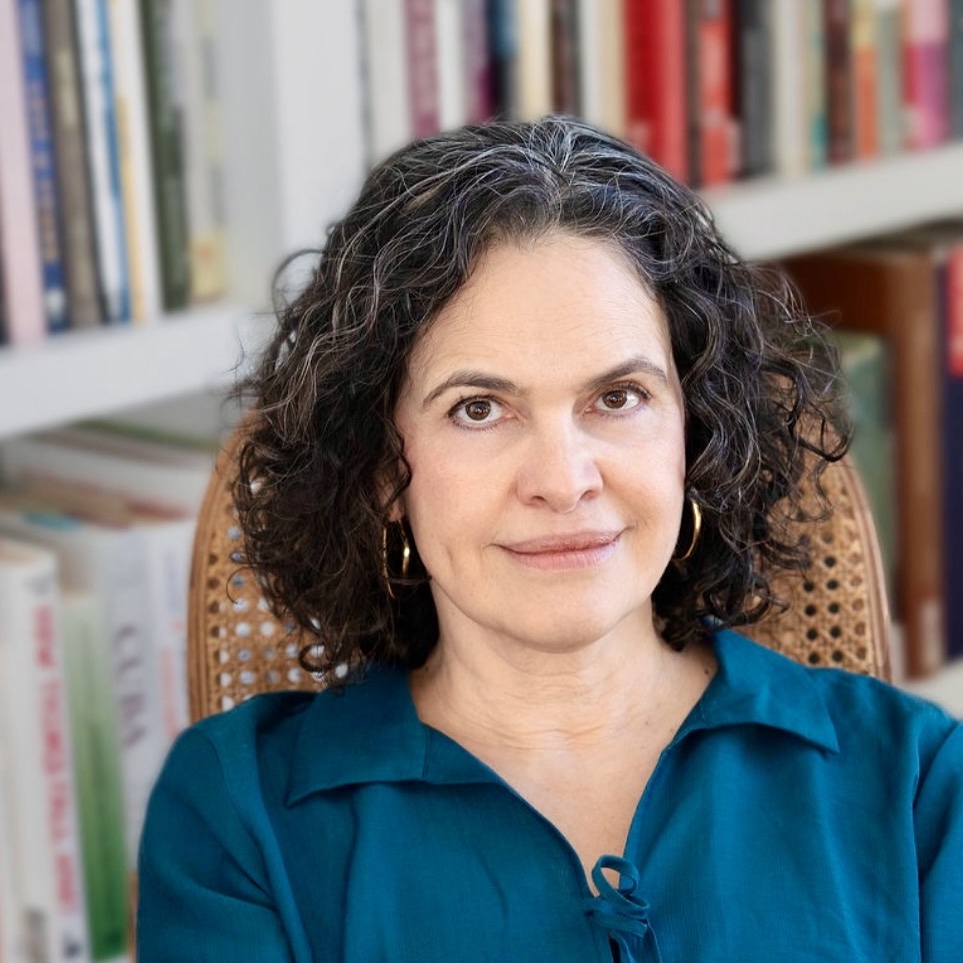
Today, we have a real treat for you. Our guest is Ada Ferrer, whose last book, An American History, won the Pulitzer Prize.
Now she's out with a new book titled Keeper of My Memoir of an Immigrant Daughter, published by Scribner.
It's an intimate, devastating, beautifully written account of her family's migration from Cuba to the United States and how the Cuban Revolution both broke and made her family. It's also a meditation on the craft of history itself, and she is a real master. If you'd like to read more of my thoughts about it, you can read my review in the Atlantic and we'll put a link on our site.
After a long time teaching at nyu, Ferrer recently moved to Princeton, where she teaches history.
You should run to get the book, but first have a listen to our episode. Thank you for tuning in to Writing Latinos.
Ada, it's so nice to talk to you. Again, congratulations on the publication of your book.
[00:02:07] Speaker A: Thank you.
[00:02:08] Speaker B: In your memoir, you know, you are at the center of a large network of family members. I would say that your mother and your father are, of course, main characters. And just so you're just so our listeners can understand something about them, I'm wondering if you can tell us just a little bit about them. And also, I'm sure you had plenty of time to think of this, however many years old you are, how you are and are like and not like your parents. What do you think you've inherited from them?
[00:02:36] Speaker A: Yeah, so my parents were born in Cuba. Obviously they were from the countryside, from different parts of the countryside, my father from the center of the island, my mother from the west.
They were pretty humble people. My mother's family didn't really have any property, and they had moved, many of them had moved to Havana in the 50s, which was a period that saw a Lot of rural migration to Havana.
And my father was from the countryside. His father had. Their. Their family had a small farm that was small enough so that it wasn't confiscated during the agrarian reform in 1959 or 1963.
[00:03:15] Speaker B: So.
[00:03:15] Speaker A: So they came from humble rural backgrounds. Both ended up in Havana in the 1950s. My father had been a stenographer, was in Cuba. You know, he got out of the countryside in part by becoming a stenographer. You know, it was something that actually a lot of rural young men did. They learned stenography and left and went to Havana and other places and joined the army or did other things. So that was his route.
And then my mother moved with her parents. As she's someone. She had been involved. She was a. My mother was a member of the authentico party in 40s and had worked in the post office for a time, which was a patronage job. A lot of jobs were patronage jobs. And she loved sewing all her own clothes. And she was very good at it.
And the family and she, and she. I say this in the book, she pressed them to perfection. No one could iron like my mother could iron. And she. The family had. They weren't. They didn't own the home they lived in, they rented it. But in the, in the house they were renting, they ran a little small restaurant called, at the time, they were called Fondas. You know, so it was a Fonda. My, my grandmother cooked, my mother cooked. They had a helper who also helped cook. My mother did all the serving and it was right near three military establishments. And that was how she met my father, who, as I said, was a stenographer in the army. So they only had a sixth grade education, but they were both incredibly smart. They could both be really stubborn.
They were both storytellers in their own way.
[00:04:48] Speaker B: And I'm sure you've had time to think about this. How, how have they rubbed off on you, do you think? What traits do you think you've inherited from them?
[00:04:57] Speaker A: I actually think quite a few. And with my mother, like, it surprised me at a certain point, maybe in my 30s, where, you know, I grew up as a very, very shy kid. I was so shy, and my mother was not shy at all. She could talk to anyone and she'd make people laugh and she'd make jokes. And at some point, I remember I was in a taxi in Miami with my niece, who was maybe about 10 then, and we're sitting in the back and I just struck up a conversation with it with the taxi driver and just kept going on and on and joking. And my niece looked at me, and I looked at her, and I knew exactly what she was thinking, that I sounded just like my mom, Right. So the older I get, you know, I've gotten less shy. I like joking with people and saying sometimes irreverent things to random people on the street, which was so her. And then, you know, I think the fact that both of them were storytellers has been really important to me. That my mother was kind of this homegrown archivist that saved everything and labeled everything. So even the artifacts in our home, she, you know, in her apartment, she labeled. So after she died, you know, like our little. The statue of the Virgin de la Carrida de Cobre, she had two of them on the bott of one with masking tape. She wrote, comprado por Papi, Miami, 1967. And then the other one said, regalo de adita mi no sientos noventa e siete Madrid.
You know, like, even that she labeled these things. And then my father, you know, late in life, began writing.
I knew he was writing. We all knew he was writing as an older man, because we could see it. But after he died and I read the papers, I came to see just how much he had written, how many different kinds of things he had written, and that he was good, you know, that he had the sense of prose and even poetry and. Which I hadn't expected. And so we share that. We both love writing. There's. There's a line I quote in the book where he says in a letter to his son, whom he also left behind.
But in this letter, he said, to write in silence is a marvelous thing. And here's this guy who was, like, probably in his 80s or 90s when he wrote that, you know, no, not much formal education, and he had just. He just came to love it.
[00:07:18] Speaker B: So even if he didn't start really writing into the. Or until the 1990s, you know, you were going to college and graduate school in the 80s and early 90s. Did any of his kind of writerly sensibilities rub off on you even before he kind of started formally writing?
[00:07:37] Speaker A: Well, there was one episode, I will tell you, in the late 90s. And at that point, I didn't. I don't think I knew yet how much he was writing. But I was finishing my first book, Insurgent Cuba, and he was visiting with my mom and my niece, and I told him that I was really struggling with the introduction to the book. Like, I just couldn't get it right. I wasn't happy with it. And my father loved nothing more than to help his daughters. He wanted to rescue us, and so he said, I'll help you. And he drafted an introduction to my book that I never used because it was very much, you know, heroic padres de la patria, you know, martyrs and all that kind of stuff that comes from. My theory is that he was influenced by. By Cuban radio in the 40s and 50s.
[00:08:28] Speaker B: So I. I want to talk about the letters, for sure. But first, since you were talking about your parents a little bit, how much of the history that you write in Keeper of My Kin came from stories they would tell you when you were young, or were you only learning a lot of these histories when you started reading the letters after their passing?
[00:08:50] Speaker A: Well, there were a few things, so there were definitely stories that I knew all my life or, you know, as long as I can remember, that they told and retold. Right.
And so. And those are in the book. But then I was lucky enough that my niece, who I've mentioned a few times, Nailah, who grew up in Miami, and so she was with my grandparents a lot. You know, my sister was working and so was her husband, so my parents would pick her up at school. Anyway, Naila, at one point, when she was in college at the University of Florida, was in that program that Paul Ortiz was running, this oral history project.
And so she did these long oral history interviews with both of them. And so I also learned some things from that that I didn't know before, which was great. And then some things I learned from.
From the letters, especially not so much from my mother's letters. I didn't have as many as of my mother's letter. I had. I had people's letters to her, but not letters that she had written. But with my father, drafts of his letters and sometimes carbon copies, he would do draft after draft of things. And he did write some autobiographical things, so I learned from that, too. And then from archival research I did, where I learned things I didn't know.
[00:10:04] Speaker B: It's a real mix. And so that's part of the work you did of putting it all together and figuring out how to narrativize all of this material you had. So the stories about your half brother, Poli, you didn't learn about those until you were an adult, Correct. That's the kind of set of stories that your mother didn't share with you when you were a child?
[00:10:27] Speaker A: No. I mean, we knew he existed, and obviously, and we knew that we'd left him behind. And all my life, I thought he would join us. I always expected him to join us. But the things in the letters about, you know, I learned all these things from the letters. His experiences of going to school, his experiences with family, how other people kind of stepped up after we were gone. That was all from the letters.
[00:10:51] Speaker B: Gotcha. I assume that a lot of listeners to this episode will know a little bit about Poli, even if they haven't read the book, because they read your article in the New Yorker about Poli. And I wanted to ask if I remember right, that article was published in 2021. Right.
And then you didn't discover kind of this new collection of letters written by Poley until 2022.
[00:11:21] Speaker A: That's right.
[00:11:22] Speaker B: Okay, so. So that must mean that there's kind of new material in the book that wasn't in the article.
[00:11:28] Speaker A: Yeah, I mean, the New Yorker piece was very condensed. The New Yorker piece I wrote as a way of grieving both my mother and my brother. Paulie died in 2020. He died, and then two weeks later, she died without knowing that he had died. And so I was just. Even though we expected my mother to die, she'd been ailing and a heart disease and all kinds of issues, and so we were expecting that. And with my bro. My brother's death came as a total surprise, but I was floored by. By it all, and. And kind of spending a lot of time in bed, not doing very much of anything. Right. They died in the. In August of 2020.
And one day I just got up and started writing. And it was really intense writing it. Like, you know, I can't do anything before I have my coffee. But when I was writing that piece, I would just take my coffee into the. Into the study and just start writing. It was just really intense. It was like I just couldn't stop.
So that was what the New Yorker piece was. And it, you know, it couldn't be that long. It was just a magazine piece. And then I decided that I wanted to take it further. And so I did get a book contract for the book. But one question I had even as I got the book contract was, how am I going to recreate Boli's life in Cuba? Because, you know, he was raised by. After we left, he was raised by my grandmother and by my aunt, whose name is also Ada, but we called her Danina, but they had both died. I have some cousins who were close with him, but I wasn't sure how much they'd be willing to share. And in the New Yorker piece Actually bullies.
Life in Havana after we left and before he came to the US is only one or two sentences.
It's just like he had a good memory, but he started getting into trouble because that's what I knew.
So his life, my reconstruction of his life comes from the letters and a few of interviews with. With cousins, but mostly from the letters for while he was in Cuba. That was the main source, the only source, really.
[00:13:37] Speaker B: Right. And which you hadn't known about. You wrote that the story of your family's migration and separation and, you know, the story's experience with history in general, and this is one of the lines that really stood out to me and struck me, is that those experiences both made and broke your family. And also that through your family's experiences, you are connected to so many other people and so many other worlds that share your experience or that are similar to your experience. And I'm wondering if you can expand on those ideas a little bit. What do you mean when you say that history kind of made and broke your family?
[00:14:13] Speaker A: Well, because I can't understand my own family without placing it in history.
Our trajectory is unthinkable, unimaginable, incomprehensible if you don't put it. If you don't situate it and anchor it really deeply in a historical context.
So our family was thoroughly shaken, shaped, and reshaped. And, you know, I think I used the word buffeted at one time that, you know, people. People are buffeted by history sometimes in ways that they don't realize. Right. So I feel like our family was buffeted by these forces that were much greater than us, which were the Cuban Revolution, on the one hand, the story of US Cuban relations, because the idea that many exiles or migrants had in the beginning that they would leave Cuba, but they would be back soon, part of what they were thinking was that the US Wouldn't let a communist regime survive.
And why did they think that? They thought that precisely because of this long history of U.S. cuban relations. Right. So even their thinking, they didn't realize at the time that even their thinking was so historically conditioned. Right. So things like that were just buffeted by these forces. The Cuban revolution, US Cuban relations, US Migration policy, which gave all these special advantages to Cubans that it didn't give to other groups that then made it easier for Cubans to contemplate leaving and so on. So all those things profoundly shaped us and kind of, they. They broke us because it's. You know, all those things had tragic consequences in the form of a family Separation and family trauma. Right. But at the same thing, it made the family. Because that's who we are. Right? That is who our family is. And so it is history that made this family.
[00:15:58] Speaker B: It makes a lot of sense. It's so interesting. But, you know, another idea that I found really compelling is that since you are a professional historian and were trained to think as a historian and read a lot of history books when you were a master's student, too, you had this moment when you were a master's student where you realized that history, as you read it, was not the same as history as your family lived it. So, yes, your family was really buffeted by history. It's hard to situate your family without situating them historically, but at the same time, they're not living outside of history. That's impossible.
[00:16:42] Speaker A: But that's impossible. But. But they don't often realize it at the time. And I think there's a sense in which some people, and I think my parents were like this. They have an idea that history is for other people, that other people make history.
What they do is just live.
And that's not the stuff of history.
And I think that's what their assumption is. Not all history writing, obviously. I mean, history, the field is much more complex than that. But there's a way in which, if you read General accounts of U.S. cuban relations or the Cuban Revolution, they can be the kinds of history that my parents imagine belonging to someone else in that it could be diplomatic history or international relations history or a history of. Of decisions made at the top, or even a.
A history of people who are protesters and activists and revolutionaries. They weren't that. They were just kind of living their life and, you know, falling in love, trying to get food on the table, that kind of thing.
[00:17:46] Speaker B: Writing Latinos is brought to you by Public Books, an online magazine of ideas, art, arts and scholarship. You can find
[email protected] that's P U B L I C b o o k s.org to donate to public books, visit publicbooks.org donate so one of the places you spent a lot of time after you moved to the United States was in West New York. You said that Cuba was an absent presence and a present absence.
And it struck me that this is so true of so many immigrant enclaves. And you write also that you didn't actually set foot in Cuba until the late 80s or early 90s, 1990s. So right then, and I'm wondering so because Cuba in West New York was an absent presence and a present absence I want to know what it felt like to you when you finally set foot in Cuba. Did it feel familiar to you because it was always an absent presence or was it still alien?
[00:18:51] Speaker A: I mean, I think probably a little bit of both. You know, I was in high school and I imagined myself to be kind of, you know, this little radical. And I want to see, like, hearts and, you know, we cut school and went to see Hearts and Minds and the Vietnam War, you know, things like. Things like that. Right. And my friends and I used to write each other. We were all in high school together. We saw each other every day. But we went through this period of writing each other letters as if we were already in college. I was going to Vassar, one of them was going to Barnard, and one was going to Bennington. And we used to write each other letters and we would make up things, you know, like, I'm leading a. I'm leading a march tomorrow.
That was the kind of thing we were. We were writing. My mother in particular was still really close to her family on the island. So she would, obviously her mother and Foley, but also to her sister who's, you know, I'm named after her.
Most of my mother's family stayed.
Most of my father's family stayed, though it was more even with them. And I just kept wondering, like, what is it that makes some people stay and some people leave?
And at the same time, like my mother and what I knew of my aunt from letters and phone calls and stuff, they seem really similar, but one had decided to stay and one had decided to leave. But they're completely the same background, right? So I just became interested with, like, are Cubans here the same as Cubans there? What is it? Does. And really, like, does. Does revolution actually change people? Which is a really interesting question. I started to become interested in those kinds of questions even in high school, though I don't know that I had the language to articulate it. So anyway, so when I went to Cuba, I had tried going twice before and it didn't work. So when I finally went in 1990, it was really hard to get there because I was born in Cuba, which meant that I couldn't. If I had been a US born graduate student, I could have gone. I would have said to the U.S. i'm doing research. And then once I got to Cuba, I would have paid, I forget, $50 for a tourist card. But as someone who was born there, I wasn't eligible for that tourist card. So I had to be allowed in. As someone who was doing research or had professional work, which is like, how do you do that? At the time, no one knew how to do that. Right. So it was hard to figure out. And so when I finally made.
Just felt so intense. Like, I got there, I couldn't go to sleep. I had to walk around. I didn't sleep hardly that trip because it just was so intense, and it felt kind of magical. And that's because one of the first places I went was the Malecon. And I don't know if you've been to Havana, but, like, the Malecon and Havana especially. I mean, now it's mostly empty and it's that much more demolished and decayed, but it wasn't yet then, and it was just packed with people sitting on the seawall and walking, and the weather was beautiful. It just felt really magical. It felt like I. I was finally seeing this place. And Havana's a beautiful city, and I love seeing it and I love meeting my family. And so it did feel like a kind of homecoming. But at the same time, I tend to think about these kinds of things, like, what would I. Who would I have been if we had stayed? You know, I used to think that. Or sometimes I would go. I remember, like, one time going to see a play.
The audience was mostly young people. And I remember thinking, is this who I would have been? So, I don't know, it just. There was something really magical and intense about it. But, yes, it wasn't all familiar. It was really hot. And if you walked around the street with, like, a drink, people would stare at you because people didn't do that. That kind of thing. I remember going to my aunt's house the first time she had this portrait of Fidel Castro in the living room. Oh, my God. What would my father say if he saw that? So, you know, so it. It was a. It was unusual.
[00:22:43] Speaker B: Among all of the other things that Keeper of My Kin is about, It's. It's kind of a meditation on the craft of history to what's knowable, what's not knowable, what the relationship is between memory and verifiable fact that's in a document, those sorts of things.
It's kind of also the story of how you became a historian of Cuba. And we've been talking about Cuba was always this place where you were born but didn't remember you didn't grow up there. Went for the first time as an adult. So I guess this question is kind of about both the proximity to Cuba and the distance from Cuba that maybe in some ways has defined your career as a historian of Cuba as well. And so I was thinking about how this also, by the way, kind of feels somewhat characteristic of the immigrant experience, where people who didn't grow up in a place where their ancestors grow up, I feel like when they're adults, they want to go back and like, master that place and come to know it very well. And it's almost. I don't want to. I don't know, should I use the word, like, roots re exploration or roots exploration or something like that? I don't know. But I guess what I'm wondering is, now that you are a historian of Cuba, have been for decades, you probably know more about the history of Cuba than 90, 95, 99% of people on Earth. And yet it's still this place that you didn't really dive into until you were an adult. So I guess what. I'm just. I'm wondering if you can talk to us a little bit about that. Can you tell us how you think of, like, what the relationship is between Ada Ferrer, the Cuban immigrant or Cuban American, and Ada Ferrer, the historian of Cuba. And now that you know so much about Cuba and have been studying it for so long, do you feel like you've come to understand it in a way that you never did before you started studying its history?
[00:24:41] Speaker A: Oh, yeah. I mean, I definitely understand it in a way that I never did before started studying. I mean, studying it. So just studying the. The long history of US Cuban relations, studying the long history of slavery and race, all those things that I think are absolutely necessary to understand Cuba today, I wouldn't have, had I not chosen to become a historian of Cuba. Even the way that people talk about, you know, a possible American invasion now, like, it's, you know, if I had been someone who grew up in Cuban New Jersey or Cuban Miami, without knowing that long history of US Cuban relations, I would probably feel differently about it. So. So I think definitely it's. I. I understand it in a way that. That I wouldn't have otherwise. I think. I mean, it's ironic that I know more about Cuban history than. Than my parents ever came to know. Right. So they thought it was weird, you know, But. But I still feel like. I mean, I. I feel like it's, you know, it's still that same thing that you were referring to, where it's this place that's mine, but not mine, though that's also how I feel about the US to some degree. Right. There are still things that, even after all these years, I think I don't understand.
And I remember I've told this story before, but in 2019, 2020, I spent a year at the Cullman center at the New York Public Library, which is where I finished writing the draft of my. My previous book, Cuban American History. And at the Cullman Center, I drafted the whole part of on the Revolution. So what I began drafting there was beginning with Fidel Castro's attack on Moncada in 1953. And I went through the very. Through the special period. I wrote that all there. And I remember one time getting out of this, walking out of the subway and walking down 40th street towards the library, and I thought, I want to live to be 97, and I want to still be sharp by then so that I can write. Because by that year, the Cuban revolution will be 100 years old.
And maybe by then I'll finally understand it.
[00:26:49] Speaker B: Do you feel like that timeline is still accurate? It's going to take you another three decades and more to fully understand it, or.
[00:26:57] Speaker A: Well, I don't know. I don't know, because I also. I work on other kinds of things, and, like, my next project probably will go back to the colonial period, so. And who knows? And I really think that you can't understand it without access to real archives, and who knows if and when that will ever happen? I mean, some stuff is available. It's not like nothing's available, but certainly not what I would want.
And then history keeps intervening and making it more complicated. Right. So, yeah.
[00:27:26] Speaker B: So a related question is, do you think you had to write a book about 500 years of Cuban history before you wrote this book about your own family? I mean, was there something you learned in the process of writing that book about a much longer time span that helped you kind of fully understand the context of your own family?
[00:27:44] Speaker A: I think I came to understand the Revolution better writing that book because I had never. I mean, my history books beforehand were. Were. Were both my first book and my second book were both colonial history books. So writing. Even though I taught the long span of Cuban history, I had never written on the Revolution before. So I came to understand a lot more about the revolution from writing that book. It was also a different kind of experience writing for a trade audience, you know, and I actually ended up really loving that. I love thinking about the writing and making it kind of accessible and lively for people who weren't already interested in Cuba, even though I still wanted it to be, you know, good history and so on. So I didn't want to pander to people But I did want to make it lively and engrossing, and I love doing that. So I think all those things helped me write this book.
But I do think that there's a part of me that was always going to write this book. Well, I don't know. Always, I think always. After my brother came to the U.S. so Polly came to the U.S. during the Mario boat lift. And by then he was a traumatized young man and had struggled in school, never completed the fifth grade, was already addicted to alcohol. Then, you know, he got even worse after coming to the States. So in some sense, seeing him in the flesh and seeing how different he was than the brother that I had imagined and waited for all my life just really crystallized the difference between me and him.
And like, the. The way that my mother's decision in 1963 set us on these radically divergent paths.
And so I think it was partly confronting him that made. I don't know if I would have written the story had, you know, had he not come then and. And been who he was. Because in college. So in 19, I think 80.
I forget whether it was 82 or 83, I wrote a short story about him, about my mother and bully and me. So I think even then I was already grappling with it. When I was in graduate school, I started writing something else about it. I think there was just a part of me that always wanted to write the story.
So I think so there's this long interest. But then you get to a certain point and you develop these skills as a historian, you develop this knowledge of Cuban history.
You develop more confidence as a writer. And then importantly, the people in the story pass away, which makes it more possible to tell.
[00:30:15] Speaker B: Can you say a little bit more about that last point, too? I mean, why did it become possible then?
[00:30:20] Speaker A: I could not have written this book if my brother was still alive.
I would have been too scared to. I don't know how he would have taken it. I would have had to have talked to him about it a lot more. And there's a part of me that will always regret not talking to him about it more when he was alive. But I also know that I couldn't. I was too scared of him. He was violent. He had been violent with me. He threatened violence.
I just could not imagine, imagine opening up this really sensitive, difficult topic with him.
[00:30:53] Speaker B: Do you think you've always kind of been writing this book anyway? I mean, the reason I ask that is that I look back and try to explain to myself why I've chosen The topics that I've chosen and ask the questions that I actually ask when I write about Latino history. And I kind of think that I've written two books about my grandpa because his experience, that's in the back of my mind whenever I write anything. So even though the books aren't about him, I think his influence very much shaped the way the questions I'm interested in, the subjects I'm interested in studying. So do you think going back now and looking at insurgent Cuba or Cuba in American history, I mean, I mean, is the family history in those books also did it shape how you saw the past that you were writing about?
[00:31:41] Speaker A: Yeah, I think so.
I think so. I'd have to think more about. About how. But I think just, I mean, first of all in the interest in Cuba. Then also we were like a mixed race family and I'd always wanted to understand that better. So the fact that I worked on race was a way to do that. I dedicated both books, both the first and the second book are. Are dedicated to my grandmother, my mother's mother, Rita Blanco, who also appears prominently in this book. So I think, you know, in the same way that you were writing about your grandfather, indirectly, I think I was writing about or for maybe my grandmother as well.
[00:32:20] Speaker B: Okay, last question. And I have to ask it because this is a Writing Latinos podcast, after all. But you write about, I think just once in the book about this experience where you kind of invoke the language of Hispanic or Latina or something, and you describe this episode when you were in college at Vassar where one of your peers told her mom that you reminded her of the family's maid who was a Hispanic. But she said that you're not a real. You either are not a real Hispanic because you're educated. So that made me wonder, you know, that was the first time I realized that in the book you hadn't used the terms Hispanic or Latina. Even the title of the book is, is I think the Memoir of an Immigrant Daughter. So immigrant, Cuban. These are terms that resonate with you more. So I'm curious if, you know, growing up in the 80s 90s, did the terms Hispanic or Latina ever resonate with you?
[00:33:10] Speaker A: I mean, this was in the 80s. I didn't know anyone who used the term Latina, though I use it now. But I think in the part where I talk about growing up and not seeing people like us reflected on television, I think I talk about only seeing two Latino characters, right? Desi Arnaz and the gardener and father Knows best and looking for. And then I don't use the word Latino, but looking for, like, Spanish surnames and stuff like that. So, no, I think we very much. We definitely thought of ourselves as Cuban, but we also thought of ourselves as. I mean, Hispanic was the word that we use then. And my mother used the word Hispanos all the time, so definitely felt very much that way. The overarching and the strongest identification was always Cuban. But then. But then right next to it on a smaller scale was Hispano, meaning, like, immigrants. And they were like, where we grew up, almost everyone was Cuban. I had some Puerto Rican classmates, and that was about it. And then by the time we left West New York, then more people were coming in, mostly from Nicaragua, some Colombia.
[00:34:18] Speaker B: Do you remember in what contexts you or your family would use. Use terms like Hispanic? Was it when you were interacting or describing your neighbors?
[00:34:30] Speaker A: So, for example, like, when I went to Vassar, my mother wouldn't ask, like, are there other Cubans there? Because that was too specific. So she would say, are there other Hispanos there? Because, you know, the sense is that someone who's an ally, who's not Americano, that was the word we used to describe Anglos. We called them Americanos. You know, it's. Which is interesting in and of itself.
It wasn't a word we used for ourselves. So I think she was asking, like, are there other Hispanos or is everyone American? That's how she would have phrased it, like, O santo Americano. And they were all practically Americano, See?
[00:35:03] Speaker B: And when you were at Texas or Michigan, did you also think about or study Latino history?
[00:35:10] Speaker A: You know, Latino history? No, I don't think it was taught when. Definitely not when I was in college. But I think even I'm trying to think. When I went to UT from 1986 to 1988, and I did history, concentrating in Latin American history.
And then in Michigan, the same thing. I think in Michigan, there were already people doing Latino history. Like, Nancy Mirabal was there at the same time I was. And. But I can't remember even then if the program was like, Latino history or if it was like, doing US History but within that, doing. Doing Latino. But no. And I think there's still this. This something that I think is so, so interesting, right? Like this fundamental lack of understanding or this confusion about who Latinos are. Right. Like, sometimes I get so mad when it's like, you know, September 15th to October 15th, we don't even get a whole full month. It's like this weird Peace thing. And you look to see who's doing something. I remember one time, like, I would look on, look on institutions websites to see what they were doing for Latino Heritage Month or Hispanic, and there would be nothing. And so one time I called the Brooklyn Museum and I said, hi, I'm just looking at your calendar and I'm trying to figure out what you're doing for Latino Heritage Month, but I don't see anything. Are you doing anything for Latino? And she's like, let me look, hold on. And she's looking and she's looking. And then she goes, oh, on Saturday we have a tour in Spanish of the collection. And I was like, but don't you do that every month? She's like, yeah, but then you see like lists of books to read for Latino Heritage Month. And it's like Gabriel Garcia Marquez.
So it's like, is it Latin American? Is it Latino? Is it in English? Is it in Spanish?
[00:36:49] Speaker B: Yeah, Frida Kahlo. Like, it's all. These are the kind of symbols of Latino identity in, In America. It's interesting.
Well, Ada, thank you so much for taking the time to talk with us.
[00:36:59] Speaker A: Oh, sure. My pleasure.
[00:37:13] Speaker B: Thank you for listening to season four of Writing Latinos. We'd love to hear your suggestions for new books that we should be reading and talking about. Drop us a line at geraldopublicbooks.org that's G E R A L D
[email protected] this episode is brought to you by Public Books. It was produced by Tasha Sandoval and our music is City of Mirrors by the Chicago based band Dos Santos. You can follow us on Blue Sky, Instagram and X to receive updates about season four of Writing Latinos. I'm Geraldo Cadava. We'll see you again soon.
Dabaga.